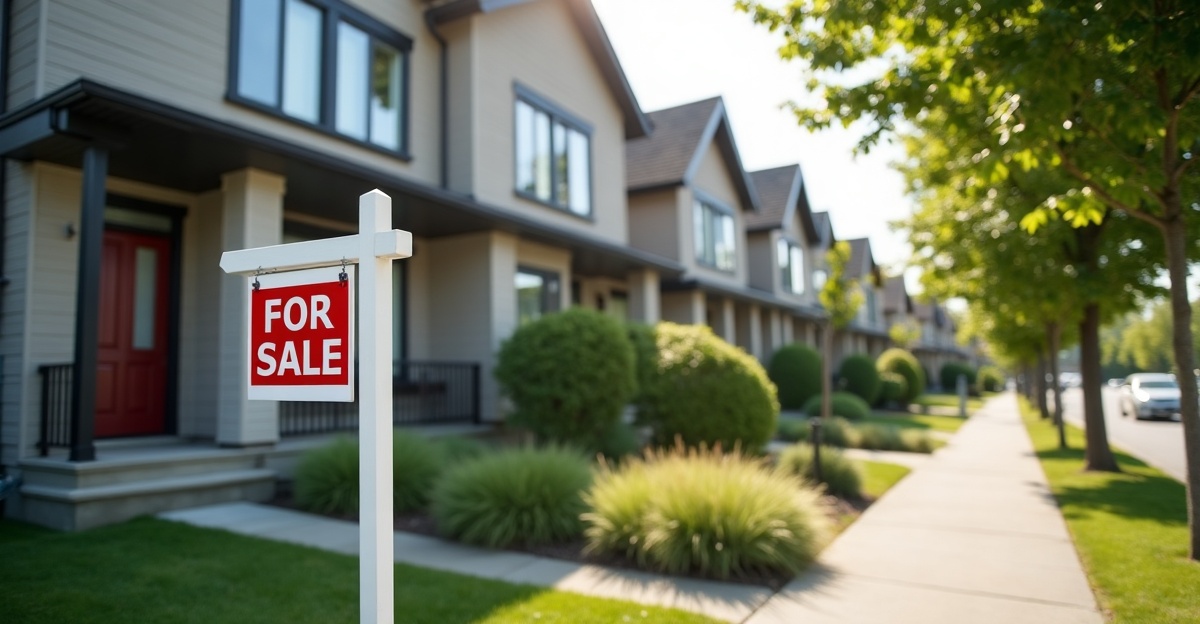
Your landlord just raised rent again. You need permission to paint. You're funding someone else's mortgage while your savings barely keep pace with inflation.
Here's the thing: ownership isn't just about pride. It's one of the few ways Canadians build wealth without daily effort. And the benefits go beyond equity.
What Does Home Ownership Give You That Renting Doesn't?
Ownership turns housing costs into forced savings. Every mortgage payment reduces principal — money you'll recover when you sell. Rent vanishes monthly.
According to Statistics Canada, home equity accounts for roughly 40% of Canadian household net worth. That's retirement cushion, emergency fund, and future leverage in one asset.
Ownership also delivers non-financial wins. No permission needed to hang shelves or adopt pets. You're building something that's yours.
How Does Equity Build Over Time?
Every payment splits two ways — interest (lender's cut) and principal (your equity). Early on, most goes to interest. By year five, you've typically built $30,000–$50,000 in equity on a $400,000 mortgage.
That equity is real money. You can tap it through refinancing, use it as down payment on a second property, or pocket it when you sell.
Compare to rent. After five years at $2,000 monthly, you've spent $120,000 with zero ownership. Your landlord gained equity. You gained flexibility.
Can Real Estate Actually Build Wealth in 2026?
Canadian real estate has appreciated 5–7% annually over two decades. Not every year. Not every market. But values trend up over time.
Imagine buying a $450,000 condo in 2021 with 10% down ($45,000). By 2026, it's worth $500,000. You've gained $50,000 in appreciation plus $35,000 in paid principal. That's $85,000 net worth growth — nearly double your down payment.
Real estate isn't stocks. You can't day-trade it. That's a feature. It forces long-term thinking.
Leverage: How Borrowing Amplifies Gains
You control a $450,000 asset with $45,000 cash. That's 10:1 leverage. When property appreciates 5%, you earn 5% on $450,000 — not just your $45,000 stake.
Most Canadian high-interest accounts pay 3–4%. On $45,000, that's $1,800 yearly. On a leveraged property? You capture gains on the full value.
Leverage cuts both ways if values drop. But over decades, Canadian prices have consistently recovered.
How Can You Use Home Equity?
Once built, you can borrow against equity through refinancing or a HELOC. According to OSFI, you can borrow up to 80% of your home's value minus outstanding mortgage.
If your home is worth $500,000 and you owe $300,000, you could access $100,000 ($500,000 × 80% = $400,000 – $300,000 outstanding).
Many use this for renovations, debt consolidation, or investment properties. It's cheaper than unsecured credit because your home backs the loan. But you're increasing debt.
What About Stability and Control?
Renters face uncertainty every lease renewal. Will your landlord sell? Raise rent 5%? Move back in? You're one notice away from packing.
Homeowners control their space. Want hardwood? Install it. Want a garden? Dig. Want an orange kitchen? It's yours.
A fixed-rate mortgage locks housing costs for 3–5 years. Rent climbs annually. Knowing your payment won't jump reduces financial stress.
How to Get Started Without Overextending
Banks approve mortgages using Gross Debt Servicing (GDS) and Total Debt Servicing (TDS) ratios. GDS measures housing costs as percentage of income (max 32–39%). TDS includes all debts (max 40–44%).
Just because you qualify for $600,000 doesn't mean you should borrow it. Lenders don't know your Netflix budget, insurance, or daycare fees. They check if you can make payments — not if you'll enjoy life while making them.
Aim below 30% GDS. That leaves room for repairs, tax hikes, and vacations without house-poor regret.
Frequently Asked Questions
What's the main financial advantage of buying versus renting in Canada?
Mortgage payments build equity — ownership that grows over time. According to Statistics Canada, home equity represents roughly 40% of Canadian household net worth. Renters build no equity regardless of payment history.
How much equity can you build in the first five years?
On a $400,000 mortgage at current rates, you'll typically build $30,000–$50,000 in paid principal by year five. Combined with appreciation averaging 5% annually, total equity gain often exceeds $80,000 in that period.
Can you borrow against home equity without selling?
Yes. OSFI allows borrowing up to 80% of your home's value minus outstanding mortgage through refinancing or a HELOC. Many homeowners use this for renovations or debt consolidation at lower rates than unsecured credit.
Ready to stop renting and start building equity? Arch Canada can match you with a mortgage broker who'll walk you through the numbers and find the best rate for your situation.