
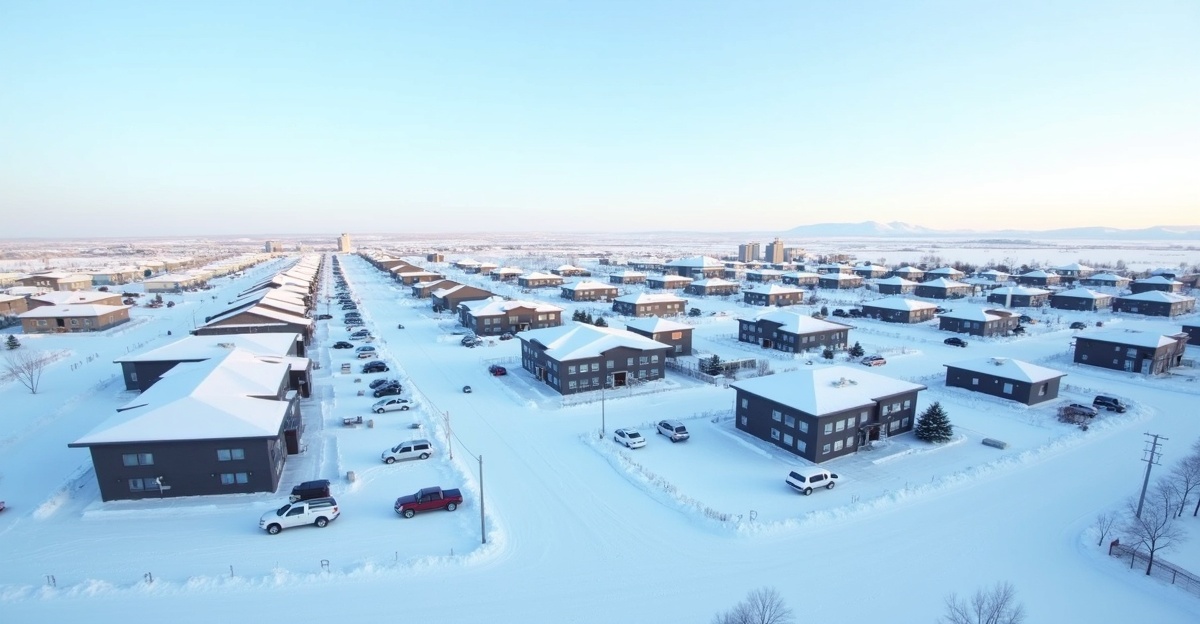
You're paying rent. Saving slowly. Then you look at housing prices in Nunavut. Average household spends 35% of income on shelter — more than double the national rate.
That's not just expensive. It's a crisis.
What's Driving the Housing Crisis in Iqaluit?
Core housing need hits harder in Nunavut than anywhere else in Canada. According to CMHC, if 30% or more of your income goes to housing costs, you're in core housing need. The national average sits at 14%. In Nunavut? 35%.
Homelessness looks different up north. It's couch surfing. Overcrowded homes. Sleeping in spaces not meant for people. The Government of Nunavut's 2020 Hidden Homelessness Survey showed how invisible the problem really is — and how urgent.
Bottom line: if you can't afford a home in Toronto, you still have options. In Iqaluit, options don't exist.
How Is Uquutaq Society Solving the Housing Gap?
The Canada Mortgage and Housing Corporation defines the problem. Uquutaq Society built the solutions.
Founded in 2009, this non-profit tackles Arctic homelessness one building at a time. Their first project? Taking over a rundown Salvation Army men's shelter — a converted four-bedroom house that was the city's only homeless shelter. By 2019, 80 people were using it at capacity, sleeping in hallways.
Now they're delivering three major projects: the Butler Building (32 supportive housing units), the Low Barrier Shelter expansion (44 beds plus Iqaluit's first year-round warming centre), and the ATCO Loop mixed-use development (48 affordable apartments). That's 124 units total in a city where housing stock barely moves.
Here's the thing — these aren't cookie-cutter builds. Each one targets a specific stage of the housing continuum: emergency shelter, transitional housing, affordable long-term rentals.
What Makes the Butler Building Different?
The Butler Building started as a 1950s prefab brought north by the U.S. Air Force. For 20 years, the city used it for storage. In 2022, Uquutaq Society won a contract to convert it into 32 single rooms with private bathrooms, plus shared kitchen and lounge space.
Funding came from National Indigenous Collaborative Housing Inc. — $10 million. Construction wraps in 2028.
This is supportive housing, not just shelter beds. Residents get stability, privacy, and program access. Real talk: privacy matters when you've been sleeping in a hallway.
Why Did Iqaluit Elders Name the Shelter "Ullivik"?
Ullivik means "a place to wait for high tide." When designing the Low Barrier Shelter expansion, mcCallumSather architects asked Iqaluit Elders for a name. The metaphor stuck.
Picture this: you're out hunting or fishing. You can't get where you need to go yet. You wait for conditions to change. That's Ullivik — a place to pause until you're ready to move forward.
The building reflects that philosophy. A three-storey structure with 44 beds, 13 transitional rooms, and a year-round drop-in centre. Instead of an elevator, designers built a long central ramp with pause points along the way — spaces where residents, visitors, and staff can connect.
Skylights and an atrium bring natural light into a building designed for Iqaluit's most vulnerable. In a city where winter daylight is scarce, that's not decoration. It's dignity.
Can You Build Affordable Housing in Downtown Iqaluit?
Uquutaq Society was the only bidder on a three-lot site in downtown Iqaluit. The lots held boarded-up, derelict homes. Now they're slated for the ATCO Loop — a four-storey mixed-use building with 48 affordable one-, two-, and three-bedroom units.
Ground floor? Commercial space leased to a local non-profit. Upper floors? Family-sized apartments with a common area. This isn't transitional housing — it's permanent, affordable rentals for people who need stability.
Partners For Affordable Housing is launching a capital fundraising campaign to cover costs. The project is still in design with mcCallumSather, but the housing development committee has been waiting since 2021 for this site to open up.
Not gonna lie — building anything in Iqaluit is expensive. Materials shipped north, short construction seasons, labour costs. But the alternative is worse: more overcrowding, more hidden homelessness, more people waiting for a home that never comes.
How Bad Is Homelessness in Northern Ontario Compared to Nunavut?
Nunavut isn't alone. Northern Ontario saw known homelessness jump 37.3% from 2024 to 2025. Since 2021? A 117.5% increase. Compare that to 49.1% provincially over the same period.
An estimated 85,000 people in Ontario were without a home in 2025, according to a recent report by the Association of Municipalities of Ontario. The Far North is one of the hardest-hit regions.
Big drop. Short timeline. No sign of slowing down.
Should You Support Community-Led Housing Projects in the North?
If you're looking for a high-return investment, northern housing projects aren't it. If you want to address a crisis that most Canadians never see, this is where the gap is widest.
Uquutaq Society's work has been recognized twice by the Nunavut legislature. That's rare. It's also telling — community-led solutions that actually listen to local needs get results.
Matthew Bolen, lead architect at mcCallumSather, puts it simply: "What we're trying to do is understand the needs of each stage along the housing continuum and deliver solutions that are appropriate and adequate for each user that aren't stigmatized."
For example, the Low Barrier Shelter doesn't just add beds. It adds a warming centre so people have somewhere safe to go year-round, not just overnight. The ATCO Loop doesn't just build apartments — it integrates commercial space to keep the block active and connected.
Common mistake: thinking northern housing projects need southern solutions. They don't. They need local insight, culturally informed design, and partners willing to work through logistical hell to get materials on-site.
Frequently Asked Questions
How much does housing cost in Nunavut compared to the rest of Canada?
The average household in Nunavut spends 35% of income on housing, compared to 14% nationally. CMHC defines core housing need as spending 30% or more — Nunavut exceeds that threshold across the board.
What is low-barrier housing and who qualifies?
Low-barrier housing removes entry requirements like sobriety or employment. Anyone experiencing homelessness can access shelter, no questions asked. Ullivik in Iqaluit provides 44 low-barrier beds plus transitional rooms for people ready for next steps.
Can you volunteer or donate to housing projects in Nunavut?
Yes. Uquutaq Society runs capital fundraising campaigns through Partners For Affordable Housing. Donations fund construction costs that can't be covered by government grants alone. Check their website for current campaigns and ways to contribute.
Ready to take the next step? Arch Canada can match you with a broker.